
Becoming Martian: How Life on Mars Will Redefine the Human Species
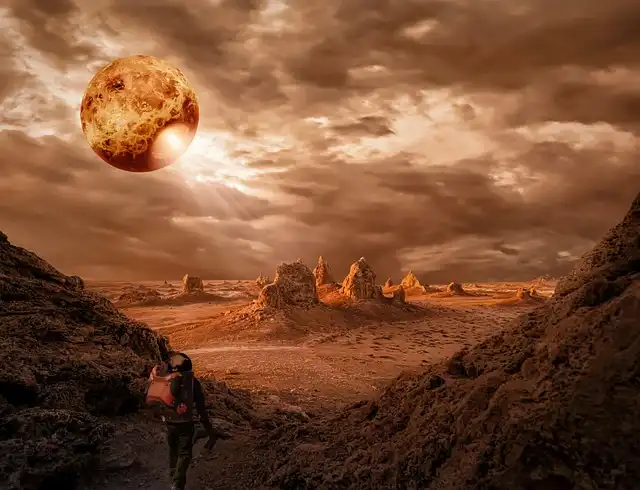
Biologist Scott E. Solomon explains how colonization could lead to distinct biological changes, from immune system shifts to natural selection, eventually evolving humans into a separate species.
It’s quite feasible a kid born and raised on Mars “would get sick if they return to Planet,” Solomon claimed, “because they would certainly have no previous exposure to the substantial majority of germs we inhale daily.” ESA/MPS et al./ SWNS
Seeing the rocket take off with his two young boys close to him, Solomon located himself much less curious about whether the designers would deal with the hardware and even more thinking about a much deeper inquiry: If humans truly were preparing to leave Earth for good, what would development do to individuals that stayed behind?
Solomon devotes much of the publication to the emotional and social obstacles of life on one more world. Being stuck with a small number of individuals for a long term period is socially difficult. All of those would certainly be real for Mars.”.
Solomon isn’t a rocket researcher. He’s a biologist, a teaching professor of ecology and transformative biology at Rice College and a research partner at the Smithsonian’s National Museum of Natural History. For much of his job, he researched how organisms adjust to brand-new environments below in the world, consisting of years of fieldwork on leafcutter ants in the Amazon rain forest.
( After Kelly invested virtually a year on the International Space Station, from March 2015 to March 2016, researchers located that the shape of his eyeball had altered, consisting of creating a thicker retinal nerve and folds in the choroid layer that surrounds the eye, impacting aesthetic skill.).
On Feb. 13, Elon Musk’s SpaceX ferried a worldwide crew of four astronauts to the International Spaceport Station, one more indicator that private firms can currently regularly carry individuals into orbit. The company continues evaluating its massive Starship rocket, which it wishes will certainly one day bring staff and freight to the moon and Mars.
The Evolutionary Shift to a Martian Identity
Human populaces that worked out remote islands developed obvious physical distinctions within centuries. Mars would certainly enforce much more extreme splitting up and much stronger discerning stress.
“The study recommends that individuals living in the extreme environment of Mars would gradually adjust via all-natural option,” he claimed. “So both culturally and naturally, individuals residing on Mars would ultimately end up being Martians.”.
Solomon approximates that after 10 or more generations, covering roughly 250 years, the collected results of isolation, selection and immune aberration can make the populaces of Planet and Mars successfully incompatible. Envisioned: a making from NASA’s 3D Printed Environment Challenge. NASA/ Mars Incubator.
“The research recommends that individuals living in the extreme setting of Mars would slowly adjust with all-natural option,” Solomon stated. Envisioned: a providing from NASA’s 3D Printed Environment Difficulty.
It’s rather feasible a youngster born and increased on Mars “would get ill if they return to Earth,” Solomon said, “since they would certainly have no prior exposure to the vast majority of microbes we breathe in each day.” ESA/MPS et al./ SWNS.
NASA’s 3D Printed Environment Difficulty recommends what life on various other earths– including Mars– may look like. “the emigration of other worlds will modify the really meaning of what it means to be human,” writer Scott E. Solomon composes in the new book “Becoming Martian.” NASA/ Team SEArch+/ Apis Cor
NASA, at the same time, is pressing ahead with its Artemis program, designed to return astronauts to the moon and use those goals as rehearsal for deeper area expedition. Mars continues to be the lasting goal.
NASA’s 3D Printed Environment Challenge recommends what life on various other earths– including Mars– may resemble. But “the emigration of various other worlds will certainly modify the very interpretation of what it indicates to be human,” writer Scott E. Solomon creates in the new publication “Becoming Martian.” NASA/ Team SEArch+/ Apis Cor.
Also on the International Space Station, where Planet is only hours away, isolation and confinement take a toll. On Mars, rescue would not be a phone call away. “Mars is a lot even more away,” Solomon stated. “At least 6 months with existing rocket science for a one-way journey.” And because the earths line up only occasionally, “there’s only a home window about every 2 years when it’s also feasible to send people back and forth.
Physical Transformations in Low Gravity Environments
We currently know that room changes grown-up bodies. “We know from astronaut studies that muscular tissues obtain weaker, bones obtain more fragile because they’re not working as hard versus gravity,” Solomon said. “We likewise find out about vision adjustments. The eye has actually architectural modifications recorded for astronauts like Scott Kelly who spent prolonged time in reduced gravity.”
The cardio system damages as well, due to the fact that the heart no more has to pump blood uphill similarly. Fluids shift up in the body. The human kind, formed by millions of years under Earth’s gravity, starts to subtly come apart.
Part of the answer, Solomon recommends, is social. After a few generations, people born upon Mars would certainly probably consider themselves as Martians initially, equally as immigrants in the world progressively concern relate to new homelands. The much deeper shift would certainly be biological.
After astronaut Scott Kelly invested almost a year on the International Space Station, from March 2015 to March 2016, scientists discovered that the form of his eyeball had actually altered, consisting of creating a thicker retinal nerve and folds up in the choroid layer that surrounds the eye, affecting visual skill. NASA.
Solomon approximates that after 10 or even more generations, spanning about 250 years, the collected impacts of isolation, selection and immune aberration might make the populaces of Planet and Mars successfully incompatible. Imagined: a making from NASA’s 3D Printed Habitat Difficulty. NASA/ Mars Incubator.
Natural selection no longer favors bodies shaped for unassisted birth. Over generations, bigger heads and narrower birth canals end up being less complicated, not harder, to pass on.
It’s fairly feasible a child birthed and elevated on Mars “would get ill if they come back to Earth,” he added, “since they ‘d have no prior direct exposure to the substantial bulk of microorganisms we inhale on a daily basis.”.
When asked what he would certainly tell his very own kids if they wanted to relocate to Mars permanently, his solution is enlightening and cautious. He would certainly urge curiosity and exploration. He ‘d fret deeply regarding a one-way journey. Earth, he mentions, is not simply acquainted. It is exceptionally tuned to our biology in methods we are just beginning to comprehend.
That does not indicate he thinks human beings should stay home permanently. He’s enthusiastic concerning exploration and scientific expeditions. Yet after five years submersed in the research, he’s come away convinced that long-term negotiation questions we’re not yet all set to respond to.
Microbial Isolation and Immune System Risks
“We have so many different kinds of bacteria on Earth,” Solomon claimed. “We have not also discovered all of them, much less industrialized injections for the wide range an individual would experience when they take their initial deep breath of Earth air.
From Silicon Valley billionaires to weekend break science-fiction fans, the discussion has actually relocated from whether human beings will certainly survive on various other globes to when. Yet a new book by transformative biologist Scott E. Solomon asks an even more unsettling concern: What takes place to mankind if we really stay?
Lessons from Earth-Based Space Simulations
Researchers have attempted to model these stress with “analog” objectives in the world, from Antarctic terminals to desert environments to the popular Biosphere 2 experiment in the 1990s, where 8 people secured themselves inside a gigantic dome in Arizona for two years. The project ended up being infamous for inner conflict, food shortages and falling oxygen degrees. Assist was only minutes away. Mars would certainly be tens of millions of miles.
On Earth, it’s educated from infancy by continuous exposure to a huge and chaotic environment of germs. “But most microorganisms on Earth will not be on Mars,” Solomon stated.
Taken together, these changes direct toward a future in which individuals born upon Mars are not just culturally various from Earthlings, however naturally distinct. Solomon approximates that after 10 or even more generations, spanning approximately 250 years, the built up impacts of isolation, selection and immune divergence could make both populaces properly incompatible. Not via intentional genetic engineering, but via the very same slow-moving, inevitable devices that have actually shaped life in the world for billions of years.
Rethinking Childbirth and Pregnancy in Space
Childbirth may be the most unsettling situation of all. “We know really little concerning maternity and giving birth in reduced gravity,” Solomon stated. “We do understand bone thickness decreases in lower gravity.” Over a life time, that consists of the hips. Solomon recommends that C-sections might become the norm for several Martian pregnancies.
After astronaut Scott Kelly spent almost a year on the International Spaceport Station, from March 2015 to March 2016, scientists located that the shape of his eyeball had actually changed, including establishing a thicker retinal nerve and folds up in the choroid layer that borders the eye, influencing aesthetic skill. NASA.
The Birth of a New Human Species
The response, Solomon suggests in “Becoming Martian: Exactly How Residing In Space Will Change Our Bodies and Minds” (MIT Press), out now, is that the descendants of today’s spacefarers may not continue to be totally compatible with the people who remain behind on Earth. They might not have the ability to return. And, over sufficient generations, they may no longer be totally the same species.
“I’m really excited about sending out individuals to the moon and Mars on scientific goals,” he said. “Yet what I came away with is recognition that we’re not yet prepared to resolve them. There are unanswered questions that need to be responded to prior to it would make sense.”.
“The research study suggests that people living in the extreme atmosphere of Mars would slowly adjust via natural selection,” Solomon claimed. Imagined: a rendering from NASA’s 3D Printed Environment Challenge.
He visited their conferences and facilities while investigating guide and came away excited by the initiative– yet doubtful that any kind of simulation can completely catch the psychological weight of irreversible splitting up from Earth.
“The study recommends that individuals living in the severe environment of Mars would slowly adapt through natural option,” Solomon stated. Solomon estimates that after 10 or even more generations, spanning roughly 250 years, the accumulated effects of seclusion, selection and immune aberration could make the populaces of Earth and Mars efficiently inappropriate. “However most germs on Earth will not be on Mars,” Solomon stated.” The research suggests that individuals living in the severe atmosphere of Mars would gradually adapt with all-natural choice,” Solomon stated. Solomon estimates that after 10 or even more generations, extending about 250 years, the accumulated results of seclusion, selection and immune aberration might make the populations of Earth and Mars effectively incompatible.
1 Becoming Martian book2 evolution
3 human biology
4 Mars colonization
5 natural selection
6 space exploration
« Reshona Landfair: Surviving R. Kelly’s Abuse & Finding Justice